
Miriam the Protector
Part 1 of 4
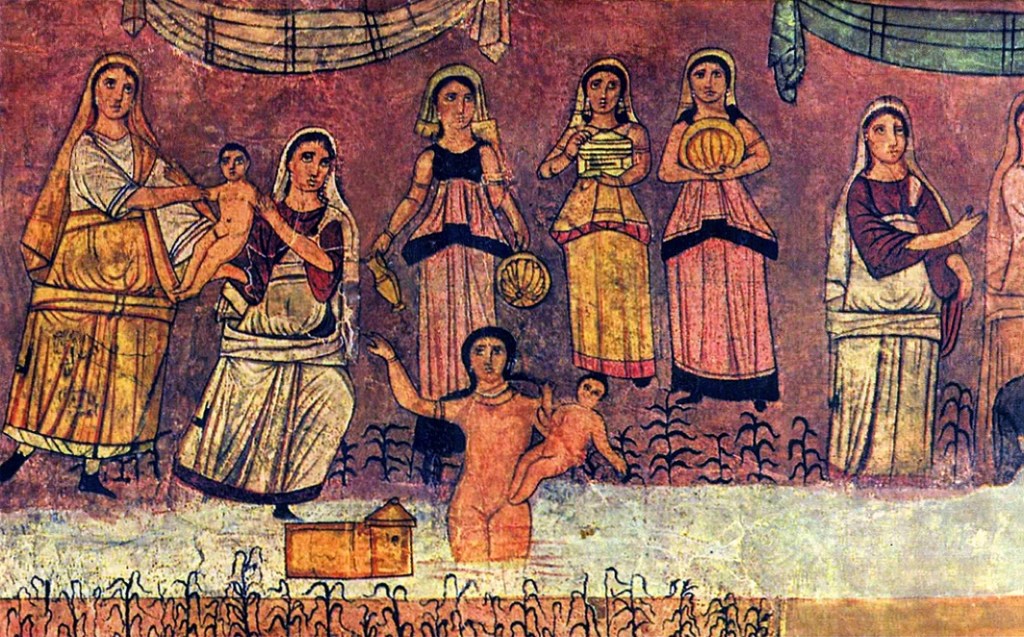
Miriam was one of Israel’s first leaders and a prophetess for her people. Unlike most women in the Bible, Miriam receives a considerable amount of textual attention. This four-part series surveys some aspects of Miriam’s character and characterization in biblical stories, non-biblical texts, and legendary material.
Miriam’s first appearance is in Exodus 2 although she is not identified by name. In Womanist Midrash, Wilda Gafney suggests that perhaps the reason she is unnamed is because of her noteriety. Regardless of the historical reasons for the young girl’s namelessness, scholars almost universally agree that this daughter is Miriam.
In the Exodus story, the unnamed Pharaoh determined that there are too many Hebrew slaves and worried that they might side with an enemy in the event of a war. He decided to treat the slaves even more ruthlessly and oppressively than before. Yet the Hebrews still multiplied their population. Pharaoh then decided that every male child born to kill every male Hebrew child. To achieve this, he assigned two Hebrew midwives to the task, Puah and Shiphrah. These midwives did not kill the children so Pharaoh took his infanticidal policy to the Egyptian people telling them, “Every boy that is born to the Hebrews you shall throw into the Nile, but you shall let every girl live” (1:22).
Moses’ mother, named Jochobed [Exodus 6:20 and Numbers 26:59], managed to hide Moses for three months. She then devised a plan that technically follows the Pharaoh’s command but does not kill her son. Placing Moses in a papyrus basket, she set him among the reeds on the bank of the river. Miriam, then, stood watch to see what would happen to her brother.*
The Pharaoh’s daughter, also unnamed, saw Moses and took pity on him, noting that he must be one of the Hebrew children. Miriam then stepped forward and asked the princess if she should secure a wetnurse for the child. Critically, Miriam asked this before the princess made any mention of adopting the child. The princess agreed and Miriam secured her mother as Moses’ wetnurse. Presumably Jochobed would have worked within the royal household though not necessarily under the princess’ supervision. After Moses was weaned, he is returned to the Pharaoh’s daughter and she raised him as her son.
By securing a wetnurse, Miriam secures survival for her brother and, ultimately, for her people. She does not wait for the Pharaoh’s daughter to speak before she boldly steps forward and negotiates her brother’s life, adoption, and care with a woman who could have had her killed alongside her brother. Jubilees extends this protector characterization by showing her to be a constant guardian for Moses while he is most vulnerable before negotiating his adoption into the Pharaoh’s household.
*The book of Jubilees (c. 160-140 BCE), a recasting of the familiar canonical texts, adds a curious detail. Jubilees 47:4 says that Moses was in the basket for 7 days, his mother would nurse him by night, and Miriam would protect him from the birds during the day.
More in the Miriam series:
Miriam, the Prophet
Miriam, the Community Leader
Miriam in Biblical History and Legend
Miriam Podcast episode
 Jillian D. Nelson, PhD
Love this!! Miriam as protector is so good!!
LikeLike