This article was first published on Working Preacher.
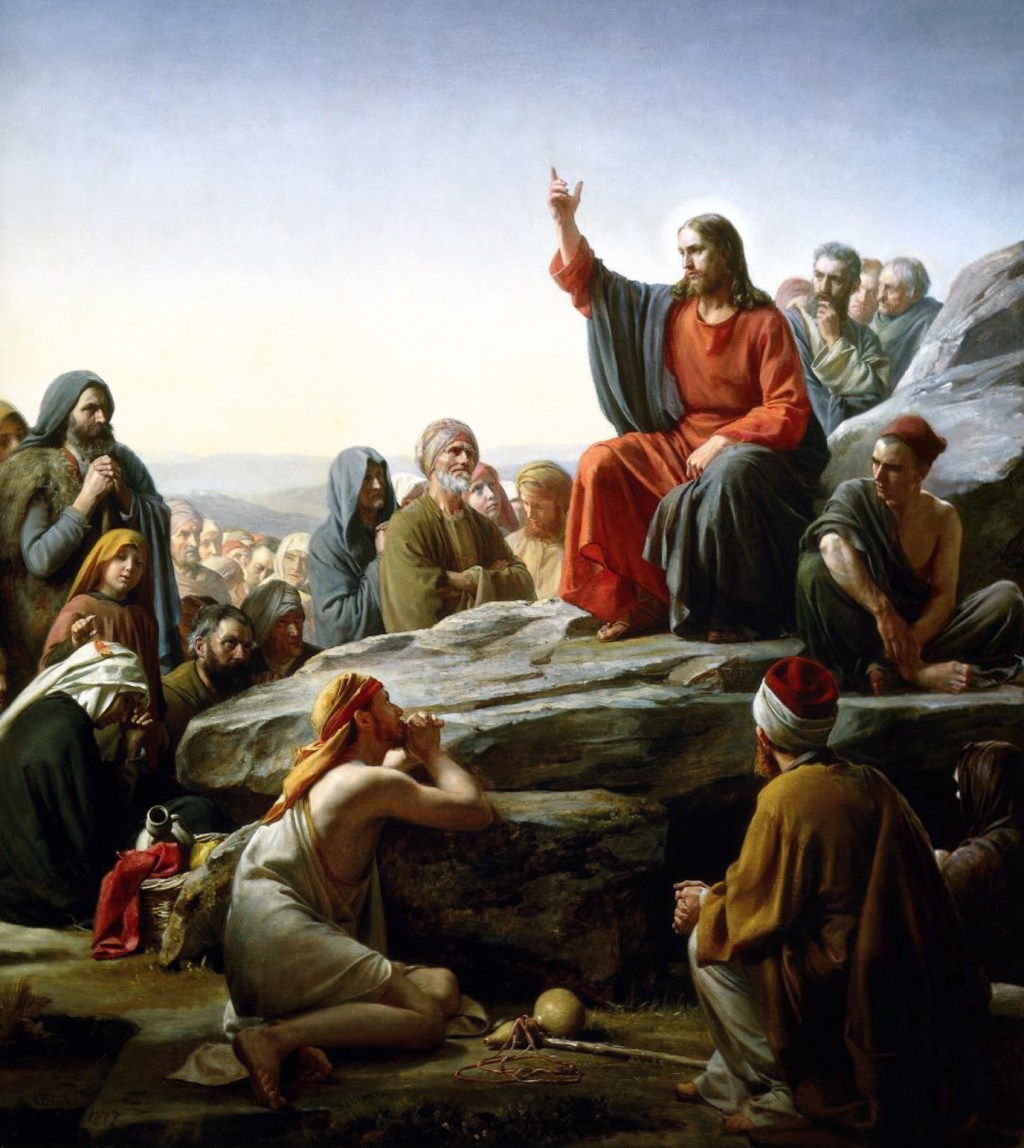
When, in Matthew 5:1, Jesus goes up the mountain with his disciples, we get our first glimpse of Jesus as an authoritative teacher. We know that Jesus is a teacher and a healer because the Sermon on the Mount follows a summary statement of Jesus’ activity: “Jesus went throughout Galilee, teaching in their synagogues and proclaiming the good news of the kingdom and curing every disease and every sickness among the people” (4:23).
Matthew shows Jesus to be an active agent of God’s power among the people and an authoritative teacher, highlighted by what is arguably the most famous of Jesus’ teachings, the Sermon on the Mount. This week’s passage is the overture, if you will, to this sermon.
The beatitudes: preamble to ministry
The beatitudes, in my mind, serve as sort of a preamble for the way in which Jesus will interpret the law and how he will conduct his ministry. So far in Matthew, Jesus has prepared for his ministry. He has been baptized. He has been tempted by Satan. He has called his first four disciples. He has taught in the synagogues, proclaimed the good news, and cured diseases and sickness.
Now, he turns to teaching his disciples (the first time they are called such in the Gospel), presumably only the four that have so far been called—Andrew, Simon Peter, James, and John. The crowds, then, serve as a sort of backdrop to this sermon. They aren’t the direct audience of the sermon, but they are presumably the recipients of the divine favor Jesus says God has in store.
It is easy, from our pews in the wealthiest country in the world, to read the beatitudes and overlook the embodiment present in them. Let’s take them each in turn.
“Blessed are the poor in spirit.” I read the poor in spirit as those who lack, who are materially bereft and therefore worn down by the plight of poverty. They are those whom society has left behind, who break their backs to make ends meet, whose struggle for basic survival crushes their spirits. Jesus says theirs is the Kingdom of Heaven, for there will be no poor in spirit there. God will set things right.
“Blessed are those who mourn.” Grief comes for all of us, but mortality rates were higher in the ancient world. Parents simply could not expect their children to survive infancy, let alone make it to adulthood. It was not a given. War, food and housing insecurity, and infectious diseases could cut a life short. And yes, it is right to grieve the loss of one’s land. Jesus’ audience was living under imperial occupation. And the audience of the Gospel, encountering this story after Rome’s destruction of Jerusalem and the Temple in 70 CE, were certainly grieved by the violation of their land and sacred space. The Promised Land was occupied. Yet, to those who mourn, Jesus proclaims a coming comfort.
“Blessed are the meek.” This is a reference to Psalm 37:11. Here “meek” refers to those who are abused by the wicked who seem only to prosper. God reassures the meek that they will inherit the land/earth. Jesus, likewise, tells the disciples that those who are abused by the wicked will inherit the land/earth—a land currently claimed and exploited by Rome for the benefit of a few. God’s rule will reverse this.
“Blessed are those who hunger and thirst for righteousness.” Righteousness in the Hebrew Bible (for example, Isaiah 51) refers to a total societal restructuring that includes the equitable distribution of resources. Those who hunger and thirst for righteousness, then, are those that Rome’s unjust distribution keeps at the margins of subsistence. In a reimagined society, all will have enough. And Jesus says that in God’s kingdom, these folks will be filled.
“Blessed are the merciful.” Jesus says that those who practice mercy, those who give of their resources and care for the outcast, will receive mercy. Rome was not known for showing mercy. Rome violently expanded its rule and heavily taxed its population to the point of food insecurity. God’s rule is different. In God’s Kingdom all will be welcome and will have plenty.
“Blessed are the pure in heart.” The pure in heart are those who follow the will of God in their thinking and doing. Jesus will parse out the importance of a person’s “heart” in discipleship later in the sermon (5:27-30). For those that commit to God thoroughly, without hypocrisy, will see God—an “image of intimate, face-to-face encounter with God.”1
“Blessed are the peacemakers.” I find this one particularly interesting, as Rome claimed to be the bearers of peace, but Rome’s peace only comes through domination. In Matthew, peace is not the absence of conflict; Jesus is well aware that his message will cause division (10:34-36). However, no one is ever coerced or forced into becoming a disciple. Rome subjugated people to their rule through threat and violence; entry into God’s kingdom is voluntary. “Peacemakers enact not the empire’s will but God’s merciful reign, living toward this wholeness and well-being and against any power that hinders or resists it.”2
For those of us living comfortable lives in the wealthiest nation the world has ever known, how can we embody the beatitudes? How can we pursue justice, righteousness, and peace? How can we embody God’s promises to those that are poor, mourn, and oppressed? When the beatitudes are rooted in embodiment, rather than spiritualized, we can more clearly see the ways we could act to bring God’s kingdom into people’s lives.
Finally, Jesus says “blessed are those who are persecuted for justice’s sake … when people revile you and persecute you and utter all kinds of evil against you falsely on my account.” The life of a disciple of Jesus runs counter to the values of the world. Perhaps we don’t experience persecution in our modern American context in the way that early Jesus followers did—no one is looking to kill us simply because we confess Christ. But do not be deceived. When we live a life for justice for the oppressed and marginalized, when we extend mercy to the outcast, when we live the values outlined in the beatitudes, the rulers of this world will resist us. But we must persevere if we are to be blessed.
Notes
- Carter, Warren. Matthew and the Margins: A Sociopolitical and Religious Reading. Orbis Books: Maryknoll, NY (2000), 135.
- Carter, Warren. Matthew and the Margins: A Sociopolitical and Religious Reading. Orbis Books: Maryknoll, NY (2000), 136.
ICE is Anti-Christ
What the Gospel stories about refugees, children, and neighbors reveal about current U.S. immigration enforcement Anti-Christ as a Pattern, not a Person I realize this is a bold statement, and that the term “anti-Christ” carries a lot of connotations. But I’m not talking about the evangelical belief that there is one Big Bad for whom…

A Reflection in the aftermath of Alex Pretti
I’m writing an Advent devotional focused on embodiment. This is what I wrote yesterday for one of the devotionals. I selected the passages some time ago, but they really resonated with the events of January 24, 2026. Psalm 40:6–8 Sacrifice and offering you do not desire, but you have given me an open ear. Burnt…

Commentary on John 1:29-42
This article was first published on Working Preacher.
As we journey through ordinary time, our lectionary turns to passages that reveal who Jesus is and lead us into deeper discipleship. The text chosen for this week, John 1:29-42, makes some striking claims about who Jesus is and how his disciples, then and now, can relate to…