Tag: Prophets

  • Miriam, Leader of Israel (4)

    Miriam in Biblical Memory and Legend

    Part 3 of 4
    Painting of Miriam. She appears to be an older woman, wearing a white top with a red draping over it. She has on a gold necklace and gold bracelet.

    Miriam was one of Israel’s first leaders and a prophetess for her people. Unlike most women in the Bible, Miriam receives a considerable amount of textual attention. This four-part series surveys some aspects of Miriam’s character and characterization in biblical stories, non-biblical texts, and legendary material.

    Miriam in Biblical Memory

    Miriam is accounted for in three genealogies and one epitaph of sorts. First, she is listed in Exodus 6:20 in the Septuagint (the name of the Greek translation of the Hebrew Bible, abbreviated LXX). It reads “And Amram took Iochabed, the daughter of his father’s brother, for his own wife, and she bore him both Aaron and Moyses and Mariam, their sister.” In Numbers 26:59, she is again named alongside her brothers, “The name of Amram’s wife was Jochebed daughter of Levi, who was born to Levi in Egypt; and she bore to Amram: Aaron, Moses, and their sister Miriam.” A final biblical genealogy lists her with her brothers in 1 Chronicles 5:29 (6:3 in English Bibles), “The children of Amram: Aaron, Moses, and Miriam.”

    Her leadership is assumed in an epitaph found in Micah 6:4: “For I brought you up from the land of Egypt, and redeemed you from the house of slavery; and I sent before you Moses, Aaron, and Miriam.”  Pseudo-Philo 20:8 serves as an extra-biblical epitaph: “And these are the three things that God gave to his people on account of three persons; that is, the well of the water of Marah for Miriam and the pillar of cloud for Aaron and the manna for Moses. And when these came to their end, these three things were taken away from them.”

    Miriam the Legend

    Several legends developed around Miriam in various Jewish circles. There was a belief (reflected in the Pseudo-Philo passage above) that because of Miriam, a mysterious well accompanied the Hebrew people in the desert. Further, the height measurement of the altar, three cubits, was said to correspond to the three deliverers of Israel: Moses, Aaron, and Miriam.1

    Several traditions refer specifically to the death of Miriam. One legend says that upon her death Moses, Aaron, and the people wept. Additionally, “For six hours, Moses was ignorant of the disappearance of Miriam’s well with Miriam’s death.”2 Miriam is the only woman listed whose death is considered atypical in Jewish tradition:

    Beside the three Patriarchs, Abraham, Isaac, and Jacob, only Moses, Aaron, and Miriam breathed their last in this manner, through the kiss of the Shekinah.  And these six, together with Benjamin, are the only ones whose corpses are not exposed to the ravages of the worms, and they neither corrupt nor decay.”3


    When he [Moses] spoke of the remarkable death that awaited Aaron, Moses meant to allude to the fact that Aaron, like his sister Miriam and later Moses, was to die not through the Angel of Death, but by a kiss from God.4

    Finally, she is, even in extended tradition, considered a prophet. One name (of four) for the mountain upon which Moses first saw the Promised Land is Nebo, “for upon it died three sinless nebi’im, “prophets,” Moses, Aaron, and Miriam.”5

    Overall reflections

    Miriam was a prophet and a cultic leader. Her leadership is presented without introduction or credentials, it is assumed. She is bold, clever, and capable of dealing with the (unmerited) repercussions of her actions. She is unafraid of approaching and challenging authority. She is caring, nurturing, and concerned for the well being of those entrusted to her. Further, Miriam is loved, deeply and profoundly, by brothers who are willing to take on God to ensure her healing.  She is respected and admired by a community that will delay their journey to their Promised Land for her sake. She is remembered as a sinless prophet worthy of being named alongside Abraham, Isaac, and Jacob. 

    But the most striking thing about Miriam is simply that she is remembered. Her stories could easily have been ignored or recast. Instead, multiple traditions have developed and her legacy can be felt today.


    Louis Ginzberg’s Legends of the Jews, 1:648
    2. Ginzberg, 1:737
    3. Ginzberg, 1:411–412
    4. Ginzberg 1:741
    5. Ginzberg, 2:814


    Other posts in this series

    Miriam the Protector

    Miriam the Prophet

    Miriam the Community Leader

  • Miriam, Leader of Israel (3)

    Miriam the Community Leader

    Part 3 of 4

    Miriam was one of Israel’s first leaders and a prophetess for her people. Unlike most women in the Bible, Miriam receives a considerable amount of textual attention. This four-part series surveys some aspects of Miriam’s character and characterization in biblical stories, non-biblical texts, and legendary material.

    In a story that exemplifies the Israelite depedence upon Miriam the leader, Numbers 12 recounts a story of Miram and Aaron confronting Moses. Though the text gives Moses’ foreign wife as the reason for Miriam and Aaron’s confrontation, what they actually say in the text to Moses is entirely unrelated: “Has the Lord spoken only through Moses? Has he not spoken through us also?” (12:3).  God overhears the confrontation and makes it perfectly clear that God and Moses have a special relationship (12:6-8). Though angry with both Aaron and Miriam, God proceeds to punish only Miriam, afflicting her with leprosy (12:9-10). Deuteronomy 24:9 reminds us of this story in instruction concerning leprosy: “Remember what the Lord your God did to Miriam on your journey out of Egypt.”

    After God punishes Miriam, Aaron immediately goes to her defense. Perhaps recognizing and acquiescing to Moses’ divinely established role as mediator, Aaron pleads to Moses to intervene for Miriam. Moses responds by crying out to God, “O God, please heal her!” (12:13).  According to Baruch Levine, the verb for Moses’ plea (to cry out, tza’aq) “expresses the language of prayer, conveying an appeal to God by one in pain.” This indicates that Moses was not merely playing mediator and passing along Aaron’s request to God. Moses’ request was borne out of pain, possibly from seeing his sister suffering and the newly freed Hebrew people potentially losing a leader. 

    God has Miriam quarantined from the camp for seven days (12:14-15a). The Israelite camp, however, “did not set out on the march until Miriam had been brought in again.”  Not only do Aaron and Moses intercede for her healing, the people do not move forward without her. This indicates that the people relied on her as a leader in her own right. God may have it out for Miriam, but Aaron, Moses, and the Israelites are firmly on her side.

    There is an extra-biblical tradition around this story that explains more clearly the conflict of Miriam and Aaron with Moses.* Zipporah (Moses’s wife) tells Miriam that since Moses was chosen to receive divine revelation, he has therefore abstained from sexual relations with her. However, neither Miriam nor Aaron, nor any of their “fathers” for that matter, were obligated to abstain because they were chosen for revelation. Miriam and Aaron decide that Moses must be doing this out of pride. 

    Like the biblical narrative, this story goes to extraordinary lengths to defend Moses’ position, God’s wrath is kindled against Aaron and Miriam, and Miriam takes the brunt of the punishment. Interestingly, Aaron and Moses’ defense of Miriam is extended. Aaron appeals to Moses by recalling all that Miriam has done as their co-leader. Moses does not need convincing because “Moses had determined, as soon as his sister became diseased, to intercede for her before God.” Moses draws a circle around himself and tells God that he will not move from it until God has healed Miriam. Further, if God will not heal Miriam, Moses says that he will do it himself. God agrees to heal Miriam, she is quarantined for a week, and, as in the biblical narrative, the Israelites wait for her return before moving forward.

    In the fourth and final part of this series, we will look at Miriam in Biblical memory and the legendary material.


    Other posts in this series

    Miriam the Protector

    Miriam the Prophet

    Miriam in Biblical Memory and Legend

  • Miriam, Leader of Israel (2)

    Miriam the Prophet

    Part 2 of 4

    Miriam was one of Israel’s first leaders and a prophetess for her people. Unlike most women in the Bible, Miriam receives a considerable amount of textual attention. This four-part series surveys some aspects of Miriam’s character and characterization in biblical stories, non-biblical texts, and legendary material.

    After Miriam’s initial appearance in Exodus 2, she next appears in Exodus 15, after the Hebrew people have fled Egypt and crossed the Reed/Red Sea. In Exodus 15:20, Miriam, explicitly called a prophet, takes up a tambourine and leads the women in dancing, singing “Sing to the Lord, for he has triumphed gloriously, horse and rider he has thrown into the sea!” Narratively, this is on the heels of Moses’ longer song of victory (15:1-18), scholars believe that Miriam’s song is perhaps the oldest portion of the Hebrew Bible (and that the longer song probably belonged to her as well!).

    A text from caves at Qumran, part of the Dead Sea Scrolls, contains an expansion of Miriam’s song. The manuscript containing the song is named 4Q365, meaning it is the 365th manuscript or fragment from the fourth cave (of eleven) at Qumran.  The extended song of Miriam says:

    …I will sing to YHWH for he has triumphed gloriously.  Yah is my strength and might…You are great, delivering your people…The enemy’s hope has perished and his memory is forgotten…Your enemies perished in the mighty waters…Your people will exalt you to the heights, for you gave a covenant to our fathers…the one doing glorious things.

    This song roots Miriam in a covenant relationship with YHWH, referring either to the Noahic covenant in Genesis 9 or the Abrahamic covenant in Genesis 15. It may also refer anachronistically to the Mosaic covenant from Exodus 20.

    Though the text explicitly names Miriam as a prophet, she does not act in ways many would understand as prophetic. That is to say, she does not foretell future events or speak on behalf of the divine to her people. Miriam’s activity here, however, is representative of a much broader understanding of prophetic activity in the ancient world. 

    Wil Gafney, in Daughters of Miriam (41), reviews the activities of biblical characters who are undisputedly considered prophets in the Hebrew Bible. Gafney’s analysis demonstrates that prophetic activity took a variety of forms:

    *intercessory prayer
    *resolving disputes
    *dancing
    *drumming
    *singing
    *giving and interpreting laws
    *working wonders

    *delivering oracles on behalf of YHWH(sometimes in ecstasy, sometimes demonstratively)
    *mustering troops and fighting battles
    *archiving their oracles in writing
    *experiencing visions

    Thus, Miriam leading the liberated Hebrew women in song immediately after their escape from Egypt is decidedly prophetic.

    Pseudo-Philo’s Latin Antiquities is a reworking of the biblical narratives from Adam to the death of King Saul. This text, compiled sometime in the mid-first to mid-second century CE, contains expansions, omissions, paraphrases, and summaries of canonical material. In this version of the Exodus 2 story, Miriam prophesies over Moses.  The text reads as follows:

    And the spirit of God came upon Miriam one night, and she saw a dream and told it to her parents in the morning, saying, “I have seen this night, and behold a man in linen garment stood and said to me, ‘Go and say to your parent, “behold he who will be born from you will be cast forth into the water; likewise through him the water will be dried up. And I will work signs through him and save my people, and he will exercise leadership always.”’” And when Miriam told of her dream, her parents did not believe her.

    As with the Biblical text, Miriam is a prophet without explanation, qualification, or credentials. In the third part of this series, I’ll examine Miriam’s role as a community leader.

  • Miriam, Leader of Israel (1)

    Miriam the Protector

    Part 1 of 4
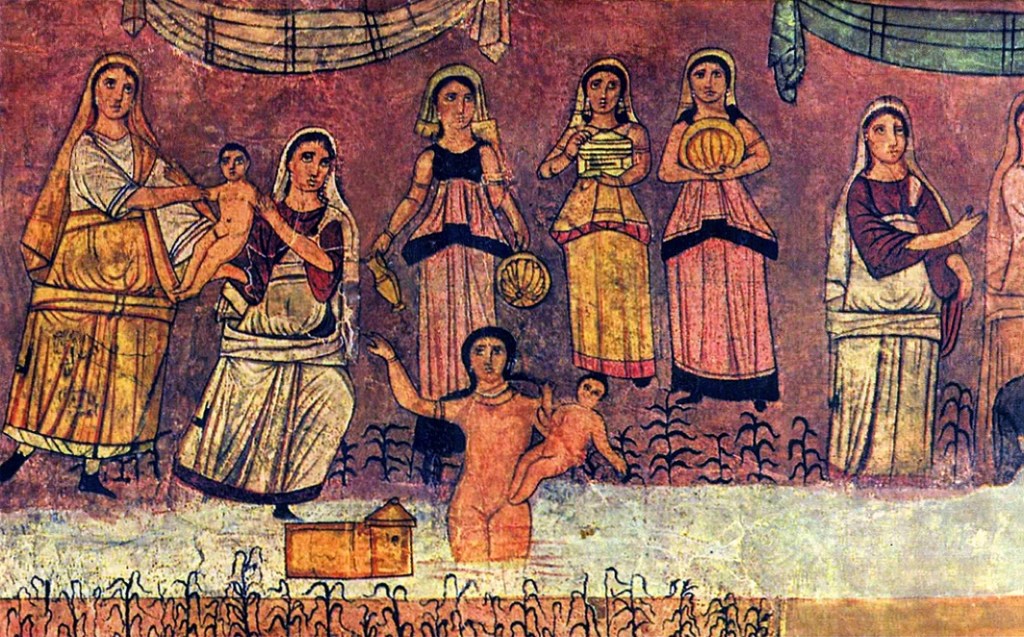
    fresco from dura-europa of egyptian princess pulling moses from water while Jochobed, Miriam, and the princess' attendants look on.

    Miriam was one of Israel’s first leaders and a prophetess for her people. Unlike most women in the Bible, Miriam receives a considerable amount of textual attention. This four-part series surveys some aspects of Miriam’s character and characterization in biblical stories, non-biblical texts, and legendary material.

    Miriam’s first appearance is in Exodus 2 although she is not identified by name. In Womanist Midrash, Wilda Gafney suggests that perhaps the reason she is unnamed is because of her noteriety. Regardless of the historical reasons for the young girl’s namelessness, scholars almost universally agree that this daughter is Miriam. 

    In the Exodus story, the unnamed Pharaoh determined that there are too many Hebrew slaves and worried that they might side with an enemy in the event of a war. He decided to treat the slaves even more ruthlessly and oppressively than before. Yet the Hebrews still multiplied their population. Pharaoh then decided that every male child born to kill every male Hebrew child. To achieve this, he assigned two Hebrew midwives to the task, Puah and Shiphrah. These midwives did not kill the children so Pharaoh took his infanticidal policy to the Egyptian people telling them, “Every boy that is born to the Hebrews you shall throw into the Nile, but you shall let every girl live” (1:22).

    Moses’ mother, named Jochobed [Exodus 6:20 and Numbers 26:59], managed to hide Moses for three months. She then devised a plan that technically follows the Pharaoh’s command but does not kill her son. Placing Moses in a papyrus basket, she set him among the reeds on the bank of the river. Miriam, then, stood watch to see what would happen to her brother.*

    The Pharaoh’s daughter, also unnamed, saw Moses and took pity on him, noting that he must be one of the Hebrew children. Miriam then stepped forward and asked the princess if she should secure a wetnurse for the child. Critically, Miriam asked this before the princess made any mention of adopting the child.  The princess agreed and Miriam secured her mother as Moses’ wetnurse. Presumably Jochobed would have worked within the royal household though not necessarily under the princess’ supervision.  After Moses was weaned, he is returned to the Pharaoh’s daughter and she raised him as her son. 

    By securing a wetnurse, Miriam secures survival for her brother and, ultimately, for her people. She does not wait for the Pharaoh’s daughter to speak before she boldly steps forward and negotiates her brother’s life, adoption, and care with a woman who could have had her killed alongside her brother. Jubilees extends this protector characterization by showing her to be a constant guardian for Moses while he is most vulnerable before negotiating his adoption into the Pharaoh’s household.


    *The book of Jubilees (c. 160-140 BCE), a recasting of the familiar canonical texts, adds a curious detail.  Jubilees 47:4 says that Moses was in the basket for 7 days, his mother would nurse him by night, and Miriam would protect him from the birds during the day.


      Other posts in this series

      Miriam the Prophet

      Miriam the Community Leader

      Miriam in Biblical Memory and Legend