
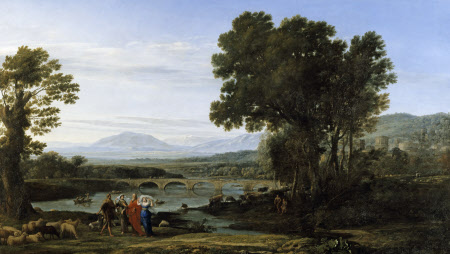
When Rachel and Leah meet their future husband
The matriarchs hold a special place in the Hebrew canon and society. They are so much more than “Jacob’s wives” or “the mothers of the Children of Israel.” Specifically, Leah and Rachel’s naming speeches reveal many things about their relationship with one another, with their shared husband Jacob, and with their God. While many readings of the birth stories of the Children of Israel focus on either the children or Jacob, I will focus on how the naming of the children reflects the interpersonal dynamics of two sisters who share a husband.
Readers learn through these speeches not only that twelve sons and one daughter are born, but also to whom they are born and the reason behind why they are named what they are. We also get a glimpse into the private lives of Rachel and Jacob, and an interesting, though not original, solution to Rachel’s struggle with infertility.
Besides Leah and Rachel, who name their children and the children of their slave-women Bilhah and Zilpah as well, only two other women in Genesis are given a voice in the naming of their children. Eve names Cain in Genesis 4:1 by saying; “I have gotten a man-child with the help of the Lord.” Tamar, in Genesis 38:29, says, “What a breach you have made for yourself!” in naming Perez.
With all the birth accounts in the book of Genesis (specific accounts such as Cain, Abel, Ishmael, Isaac, Jacob, Esau and basic genealogies) it is quite significant that Leah and Rachel not only name all twelve of the male children, but also, with the exception of Benjamin, are given the stage to say why they named them.
It is noteworthy that, while Dinah, Leah’s daughter, is named and is therefore more privileged than most women in the Bible, there is no speech accompanying her naming to explain the meaning.
Setting the Scene
Before getting into the birth of the children and their naming speeches, let’s first get a handle on what’s going on in the story leading up to our passage. Genesis 28:1-29:30 recounts these events.
Jacob has left his home with his father Isaac’s charge to find a wife among his mother Rebekah’s kin, specifically her brother’s daughters. This is an example of the endogamous marriage that is typical of the ancestral stories of Israel. Abram and Sarai were half-siblings sharing a father while Isaac and Rebekah were cousins once removed since Rebekah was Abram’s great-niece. Isaac is now encouraging Jacob to find a wife from his pool of first cousins.
Isaac has wished the blessing of God to be upon Jacob so that he may be fruitful and multiply. On his way to Laban’s, Jacob has a dream in which God tells him that his descendants will be “as the dust of the earth,” that is to say uncountable or multitudinous. From early in the narrative, it is insinuated that God alone is in control of Jacob’s progeny, and only God knows how numerous that progeny will be.

We are first introduced to Rachel at the well where her father Laban watered his flock. Rachel is a shepherd who has brought her father’s flocks to the well.
Wil Gafney highlights the importance of Rachel’s role as shepherd since “shepherding is a powerful and dominant metaphor for leading the people of Israel as a civil (monarch) and religious (prophet) leader and for God’s own care of God’s people.”1 Gafney reminds us that the imagery is sustained into the New Testament with descriptions of Jesus and later into our modern congregations as a metaphor for pastoral leadership.
Jacob meets Rachel at the well and this leads to the dramatic scene in which Jacob rolls the large stone away from the well by himself, kisses Rachel, and weeps. Later, Jacob meets Laban and agrees to work for him for seven years so that Rachel, the younger of Laban’s two daughters, might be his wife.
We are briefly introduced to Leah in 29:17 and told that she is older than Rachel and that she had “weak eyes,” whatever that might mean. Perhaps it means there was something wrong with her eyes or perhaps it means there was something peculiar about how she sees. Contrast this to the description of Rachel as being beautiful of form and face.
Rachel is the focus of Jacob’s affection; Leah proves to be a foil to his love story.
The Marriages
After seven years, Jacob has earned the right to marry Laban’s daughter. He anticipates Rachel, but on the wedding night, Laban substitutes Leah. Jacob awakens the next morning to quite the wedding gift: “So it came about in the morning that, behold, it was Leah!” (29:25).
Just as a sidenote: how did he not realize who she was before the marriage was consummated??? Men, do better.
Back to the story: Angry, Jacob confronts Laban. Laban tells him it is customary to marry the older before the younger so Jacob agrees to work seven more years for Rachel. Genesis 29:30 rounds out this portion of the narrative. The audience is informed that Jacob loved Rachel more than he loved Leah, implying that he did love Leah – he just loved Rachel more.
Despite his greater love toward Rachel, it is Leah who is carrying Jacob’s first child.


 Jillian D. Nelson, PhD
6 thoughts on “The Mothers of the Children of Israel (1)”