Category: Blog

This blog gathers my public scholarly work on Scripture, disability, and embodied life in community. Here you’ll find close readings of biblical texts, especially stories of women and healing, alongside reflections on empire, state violence, and public grief. I also write about teaching the Bible with bodies in mind—designing accessible courses, engaging hard texts, and supporting ministers and students as they interpret Scripture for their own contexts.

  • The Mothers of the Children of Israel (2)

    The Mothers of the Children of Israel (2)

    Leah’s Loveless but Productive Marriage

    The matriarchs hold a special place in the Hebrew canon and society.  They are so much more than “Jacob’s wives” or “the mothers of the Children of Israel.”  This blog explores a bit of they dynamic of Leah’s marriage to Jacob.

    Before learning of Leah’s conception, the text states that God saw that Leah was unloved (some translations such as the King James Version translate the word as hated) and opened her womb while Rachel was barren.  Before both sections of Leah’s birth speeches, the text states that God is responsible for her fertility; God “opened her womb” at 29:31 and “gave heed” to her at 30:17.  Before the birth of Joseph, after Jacob has ten sons and one daughter, God finally remembered Rachel and “opened her womb” at 30:22. 

    Reproduction in the Ancient World

    The society in which Leah and Rachel lived is a far cry from the world we inhabit.  Strategically planning pregnancies would have required an understanding of the female reproductive system beyond the knowledge of ancient folk and, quite frank, beyond the interest of ancient men; medical procedures like invitro and fertility drugs were obviously unavailable; and standardized pre-natal care was not an option. 

    Children were essential to the fuctioning of ancient household. Further, the importance of male offspring was rooted in the patriarchal societal structure of ancient Israel. Lineage was traced through the male, and with no sons, a man’s lineage ended.  Allow me to quote Sharon Pace Jeansonne at length:

    “Be fruitful and multiply” (1:28) is the first command of God in the Book of Genesis, and fertility is always associated with blessing throughout the Hebrew Bible.  In a society where population growth was desirable and equated with political strength, and where infant mortality was high, neither men nor women believed that not wanting children was acceptable.  The goal in the agrarian society was to have as many children as possible, and pray that they were boys. he stories of the matriarchs reveal the patriarchal goal of having sons to add to a man’s prestige and material well-being.  However, they also present the prominent theological perspective that the God who calls Abraham out of Ur keeps the promise of descendants and is a powerful God of fertility.1

    The goal in the agrarian society was to have as many children as possible, and pray that they were boys. 

    “Now the Lord saw that Leah was hated.”

    Returning to Leah, Genisis 29:31 tells us that she was “sane’.” Gafney reminds us that the word used here doesn’t simply mean unloved or loved less, but hated.  However, “the text does not say that she is hated by Jacob, leaving open the possibility that she is hated by her husband, sister, and/or father, and perhaps others.”2 The uses of this same word in the Joseph stories might shed some light on this, if one assumes that it is either Jacob or Rachel who “hates” Leah.

    In the Joseph narrative, the brothers “hate” Joseph.  He is arrogant and acting as if he were the oldest of the sons.  They first hate him in 37:4 when they see that Jacob loves him more (Jacob is notorious at playing favorites), they hate him more when Joseph tells the brothers his dream in 37:5, and they hate him even more when they realize in 37:8 that the dream means Joseph will have dominion over them. 

    Within this context, at least, this word seems to mean more than an emotional response, though not completely separate from it.  Joseph’s brothers hate him because he is a younger son acting as if he is the eldest.  He’s operating in a position that, at least in his brothers’ minds, does not belong to him. 

    Taking this into consideration, the problem in the Leah/Jacob union is not Leah; it is that Leah is not Rachel.  Leah is the first wife, the chief wife.  She is also the wife that is producing offspring.  Jacob worked fourteen years for Rachel.  Jacob wanted Rachel from the moment they met.  Laban tricked Jacob into marrying Leah.  There is cause for either Jacob or Rachel, if not both, to “hate” Leah since she holds a position that, by their estimation, ought to belong to Rachel.

    A Complicated Marriage

    Now, whatever this hatred meant sexually for Leah and Jacob is unclear.  What the text does reveal about their marital relationship is two-fold. First, she bore him six sons and one daughter, presumably within the (second set of) seven years he was working for Laban to “earn” Rachel, although Gafney suggests that it could be over a longer period of time if one assumes that Leah does not get pregnant again until after the previous child is weaned.  Either way, this indicates the fertility of Leah. 

    Secondly, Leah did not control Jacob’s sexual activity as much as Rachel did.  This is demonstrated in 30:15 when Rachel gives Leah permission to have sex with Jacob. 

    You may be asking: “if he didn’t like her, couldn’t he just divorce her?”  The answer is yes, but there could be several reasons why Jacob did not divorce Leah.  Perhaps he was afraid of what Laban might do if he did.  Perhaps he felt an obligation toward his kinswoman that would not allow him to forsake her completely.  Or perhaps he realized that she was the wife that would provide the children to carry on his lineage. 

    The text does not indicate any reason why Jacob did not divorce Leah.  There was no Torah to define his actions, but there must have been something that kept Jacob bound to Leah, but whatever that something is, the author either takes it for granted or finds it to be of little import for the purpose of this narrative.

    So, as I’ve already stated, Leah is the first to become pregnant, and the narrative sets Leah’s fertility and rejection by Jacob in contrast with Rachel’s barrenness and favor.  Leah bears four children consecutively in 29:31-35.  The first three naming speeches are all linked to her relationship with Jacob, and three of the four are connected to her belief in God.  These naming speeches will be discussed in later posts.

    Just for fun: what if all of Leah’s pregnancies were in that first 7 years?

    In Leviticus 12, the days of ritual uncleanness after the birth of a child are laid out for women based on the sex of the child.  It is unlikely that Jacob and the women would have practiced such strict guidelines, as this story is set in a time prior to the giving of the law. Regardless, of the amount of time spent after the birth of one child and the conception of the next, it is evident that Leah spent very little of her first years of marriage without being pregnant if one assumes these pregnancies all occurred during the second set of 7 years Jacob worked for Laban. 

    It that is the case, she had seven children in seven years! 

    Just for fun, if one assumes that a) all of these pregnancies occurred in the second set of 7 years that Jacob worked for Laban to earn Rachel and b) that all seven of Leah’s pregnancies were full term, that is 40 weeks, then, there were only 595 days over those 7 years that she was not pregnant. 

    When you further consider that her slave-woman Zilpah gives birth to two more children for her then that means there are only 35 days over that 7 years that Leah is not pregnant or concerned with a pregnancy.

    It’s possible that Leah’s perpetual pregnancies, rather than Rachel’s control, may be the cause of minimal sexual activity between her and her husband.  Genesis 30:9 says that “Leah saw that she stopped bearing,” but the text gives no indication that it is due to a sexual abstinence with Jacob.  What the text does indicate is that, regardless of how many children Leah were to bear for Jacob he would never satisfy Leah’s desire for him.  This becomes evident in the speeches that accompany the naming of her children. 

    Leah’s level of fertility borders on the absurd and is a clear indication that the author of the text is more concerned with continuing the theme of God’s divine intervention in the lives of the ancestral families than it is with relaying “facts” in the way that we moderns would prefer. 


    1. Sharon Pace Jeansonne. The Women of Genesis: From Sarah to Potiphar’s Wife, (Minneapolis: Fortress Press, 1990), 79.
    2. Wilda C. Gafney, Womanist Midrash: A Reintroduction to the Women of the Torah and the Throne (Westminster John Knox Press: Louisville, 2017), 64.


    Other posts in this series

    Leah and Rachel Meet Jacob

    Leah’s First Four Sons

    Bilhah and Zilpah: The Enslaved Matriarchs
    Mandrakes and Three More Children for Leah

    Rachel’s Long-Awaited Sons

  • The Mothers of the Children of Israel (1)

    The Mothers of the Children of Israel (1)

    When Rachel and Leah meet their future husband

    The matriarchs hold a special place in the Hebrew canon and society.  They are so much more than “Jacob’s wives” or “the mothers of the Children of Israel.”  Specifically, Leah and Rachel’s naming speeches reveal many things about their relationship with one another, with their shared husband Jacob, and with their God. While many readings of the birth stories of the Children of Israel focus on either the children or Jacob, I will focus on how the naming of the children reflects the interpersonal dynamics of two sisters who share a husband.

    Readers learn through these speeches not only that twelve sons and one daughter are born, but also to whom they are born and the reason behind why they are named what they are.  We also get a glimpse into the private lives of Rachel and Jacob, and an interesting, though not original, solution to Rachel’s struggle with infertility.

    Besides Leah and Rachel, who name their children and the children of their slave-women Bilhah and Zilpah as well, only two other women in Genesis are given a voice in the naming of their children.  Eve names Cain in Genesis 4:1 by saying; “I have gotten a man-child with the help of the Lord.”  Tamar, in Genesis 38:29, says, “What a breach you have made for yourself!” in naming Perez. 

    With all the birth accounts in the book of Genesis (specific accounts such as Cain, Abel, Ishmael, Isaac, Jacob, Esau and basic genealogies) it is quite significant that Leah and Rachel not only name all twelve of the male children, but also, with the exception of Benjamin, are given the stage to say why they named them. 

    It is noteworthy that, while Dinah, Leah’s daughter, is named and is therefore more privileged than most women in the Bible, there is no speech accompanying her naming to explain the meaning.

    Setting the Scene

    Before getting into the birth of the children and their naming speeches, let’s first get a handle on what’s going on in the story leading up to our passage.  Genesis 28:1-29:30 recounts these events.

    Jacob has left his home with his father Isaac’s charge to find a wife among his mother Rebekah’s kin, specifically her brother’s daughters.  This is an example of the endogamous marriage that is typical of the ancestral stories of Israel.  Abram and Sarai were half-siblings sharing a father while Isaac and Rebekah were cousins once removed since Rebekah was Abram’s great-niece.  Isaac is now encouraging Jacob to find a wife from his pool of first cousins. 

    Isaac has wished the blessing of God to be upon Jacob so that he may be fruitful and multiply.  On his way to Laban’s, Jacob has a dream in which God tells him that his descendants will be “as the dust of the earth,” that is to say uncountable or multitudinous.  From early in the narrative, it is insinuated that God alone is in control of Jacob’s progeny, and only God knows how numerous that progeny will be.

    We are first introduced to Rachel at the well where her father Laban watered his flock.  Rachel is a shepherd who has brought her father’s flocks to the well.

    Wil Gafney highlights the importance of Rachel’s role as shepherd since “shepherding is a powerful and dominant metaphor for leading the people of Israel as a civil (monarch) and religious (prophet) leader and for God’s own care of God’s people.”1  Gafney reminds us that the imagery is sustained into the New Testament with descriptions of Jesus and later into our modern congregations as a metaphor for pastoral leadership.  

    Jacob meets Rachel at the well and this leads to the dramatic scene in which Jacob rolls the large stone away from the well by himself, kisses Rachel, and weeps.  Later, Jacob meets Laban and agrees to work for him for seven years so that Rachel, the younger of Laban’s two daughters, might be his wife. 

    We are briefly introduced to Leah in 29:17 and told that she is older than Rachel and that she had “weak eyes,” whatever that might mean.  Perhaps it means there was something wrong with her eyes or perhaps it means there was something peculiar about how she sees.  Contrast this to the description of Rachel as being beautiful of form and face. 

    Rachel is the focus of Jacob’s affection; Leah proves to be a foil to his love story.

    The Marriages

    After seven years, Jacob has earned the right to marry Laban’s daughter.  He anticipates Rachel, but on the wedding night, Laban substitutes Leah.  Jacob awakens the next morning to quite the wedding gift: “So it came about in the morning that, behold, it was Leah!” (29:25). 

    Just as a sidenote: how did he not realize who she was before the marriage was consummated??? Men, do better. 

    Back to the story: Angry, Jacob confronts Laban.  Laban tells him it is customary to marry the older before the younger so Jacob agrees to work seven more years for Rachel.  Genesis 29:30 rounds out this portion of the narrative. The audience is informed that Jacob loved Rachel more than he loved Leah, implying that he did love Leah – he just loved Rachel more. 

    Despite his greater love toward Rachel, it is Leah who is carrying Jacob’s first child.


    1. Wilda C. Gafney, Womanist Midrash: A Reintroduction to the Women of the Torah and the Throne (Westminster John Knox Press: Louisville, 2017), 54.


    Other posts in this series

    Leah’s Loveless Marriage

    Leah’s First Four Sons

    Bilhah and Zilpah: The Enslaved Matriarchs

    Mandrakes and Three More Children for Leah

    Rachel’s Long-Awaited Sons

  • Miriam, Leader of Israel (4)

    Miriam in Biblical Memory and Legend

    Part 3 of 4
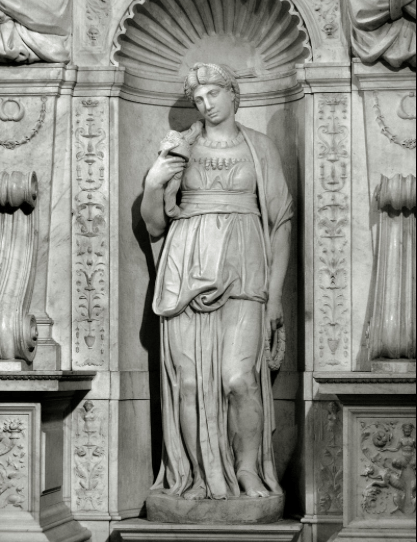
    Painting of Miriam. She appears to be an older woman, wearing a white top with a red draping over it. She has on a gold necklace and gold bracelet.

    Miriam was one of Israel’s first leaders and a prophetess for her people. Unlike most women in the Bible, Miriam receives a considerable amount of textual attention. This four-part series surveys some aspects of Miriam’s character and characterization in biblical stories, non-biblical texts, and legendary material.

    Miriam in Biblical Memory

    Miriam is accounted for in three genealogies and one epitaph of sorts. First, she is listed in Exodus 6:20 in the Septuagint (the name of the Greek translation of the Hebrew Bible, abbreviated LXX). It reads “And Amram took Iochabed, the daughter of his father’s brother, for his own wife, and she bore him both Aaron and Moyses and Mariam, their sister.” In Numbers 26:59, she is again named alongside her brothers, “The name of Amram’s wife was Jochebed daughter of Levi, who was born to Levi in Egypt; and she bore to Amram: Aaron, Moses, and their sister Miriam.” A final biblical genealogy lists her with her brothers in 1 Chronicles 5:29 (6:3 in English Bibles), “The children of Amram: Aaron, Moses, and Miriam.”

    Her leadership is assumed in an epitaph found in Micah 6:4: “For I brought you up from the land of Egypt, and redeemed you from the house of slavery; and I sent before you Moses, Aaron, and Miriam.”  Pseudo-Philo 20:8 serves as an extra-biblical epitaph: “And these are the three things that God gave to his people on account of three persons; that is, the well of the water of Marah for Miriam and the pillar of cloud for Aaron and the manna for Moses. And when these came to their end, these three things were taken away from them.”

    Miriam the Legend

    Several legends developed around Miriam in various Jewish circles. There was a belief (reflected in the Pseudo-Philo passage above) that because of Miriam, a mysterious well accompanied the Hebrew people in the desert. Further, the height measurement of the altar, three cubits, was said to correspond to the three deliverers of Israel: Moses, Aaron, and Miriam.1

    Several traditions refer specifically to the death of Miriam. One legend says that upon her death Moses, Aaron, and the people wept. Additionally, “For six hours, Moses was ignorant of the disappearance of Miriam’s well with Miriam’s death.”2 Miriam is the only woman listed whose death is considered atypical in Jewish tradition:

    Beside the three Patriarchs, Abraham, Isaac, and Jacob, only Moses, Aaron, and Miriam breathed their last in this manner, through the kiss of the Shekinah.  And these six, together with Benjamin, are the only ones whose corpses are not exposed to the ravages of the worms, and they neither corrupt nor decay.”3


    When he [Moses] spoke of the remarkable death that awaited Aaron, Moses meant to allude to the fact that Aaron, like his sister Miriam and later Moses, was to die not through the Angel of Death, but by a kiss from God.4

    Finally, she is, even in extended tradition, considered a prophet. One name (of four) for the mountain upon which Moses first saw the Promised Land is Nebo, “for upon it died three sinless nebi’im, “prophets,” Moses, Aaron, and Miriam.”5

    Overall reflections

    Miriam was a prophet and a cultic leader. Her leadership is presented without introduction or credentials, it is assumed. She is bold, clever, and capable of dealing with the (unmerited) repercussions of her actions. She is unafraid of approaching and challenging authority. She is caring, nurturing, and concerned for the well being of those entrusted to her. Further, Miriam is loved, deeply and profoundly, by brothers who are willing to take on God to ensure her healing.  She is respected and admired by a community that will delay their journey to their Promised Land for her sake. She is remembered as a sinless prophet worthy of being named alongside Abraham, Isaac, and Jacob. 

    But the most striking thing about Miriam is simply that she is remembered. Her stories could easily have been ignored or recast. Instead, multiple traditions have developed and her legacy can be felt today.


    Louis Ginzberg’s Legends of the Jews, 1:648
    2. Ginzberg, 1:737
    3. Ginzberg, 1:411–412
    4. Ginzberg 1:741
    5. Ginzberg, 2:814


    Other posts in this series

    Miriam the Protector

    Miriam the Prophet

    Miriam the Community Leader

  • Miriam, Leader of Israel (3)

    Miriam the Community Leader

    Part 3 of 4

    Miriam was one of Israel’s first leaders and a prophetess for her people. Unlike most women in the Bible, Miriam receives a considerable amount of textual attention. This four-part series surveys some aspects of Miriam’s character and characterization in biblical stories, non-biblical texts, and legendary material.

    In a story that exemplifies the Israelite depedence upon Miriam the leader, Numbers 12 recounts a story of Miram and Aaron confronting Moses. Though the text gives Moses’ foreign wife as the reason for Miriam and Aaron’s confrontation, what they actually say in the text to Moses is entirely unrelated: “Has the Lord spoken only through Moses? Has he not spoken through us also?” (12:3).  God overhears the confrontation and makes it perfectly clear that God and Moses have a special relationship (12:6-8). Though angry with both Aaron and Miriam, God proceeds to punish only Miriam, afflicting her with leprosy (12:9-10). Deuteronomy 24:9 reminds us of this story in instruction concerning leprosy: “Remember what the Lord your God did to Miriam on your journey out of Egypt.”

    After God punishes Miriam, Aaron immediately goes to her defense. Perhaps recognizing and acquiescing to Moses’ divinely established role as mediator, Aaron pleads to Moses to intervene for Miriam. Moses responds by crying out to God, “O God, please heal her!” (12:13).  According to Baruch Levine, the verb for Moses’ plea (to cry out, tza’aq) “expresses the language of prayer, conveying an appeal to God by one in pain.” This indicates that Moses was not merely playing mediator and passing along Aaron’s request to God. Moses’ request was borne out of pain, possibly from seeing his sister suffering and the newly freed Hebrew people potentially losing a leader. 

    God has Miriam quarantined from the camp for seven days (12:14-15a). The Israelite camp, however, “did not set out on the march until Miriam had been brought in again.”  Not only do Aaron and Moses intercede for her healing, the people do not move forward without her. This indicates that the people relied on her as a leader in her own right. God may have it out for Miriam, but Aaron, Moses, and the Israelites are firmly on her side.

    There is an extra-biblical tradition around this story that explains more clearly the conflict of Miriam and Aaron with Moses.* Zipporah (Moses’s wife) tells Miriam that since Moses was chosen to receive divine revelation, he has therefore abstained from sexual relations with her. However, neither Miriam nor Aaron, nor any of their “fathers” for that matter, were obligated to abstain because they were chosen for revelation. Miriam and Aaron decide that Moses must be doing this out of pride. 

    Like the biblical narrative, this story goes to extraordinary lengths to defend Moses’ position, God’s wrath is kindled against Aaron and Miriam, and Miriam takes the brunt of the punishment. Interestingly, Aaron and Moses’ defense of Miriam is extended. Aaron appeals to Moses by recalling all that Miriam has done as their co-leader. Moses does not need convincing because “Moses had determined, as soon as his sister became diseased, to intercede for her before God.” Moses draws a circle around himself and tells God that he will not move from it until God has healed Miriam. Further, if God will not heal Miriam, Moses says that he will do it himself. God agrees to heal Miriam, she is quarantined for a week, and, as in the biblical narrative, the Israelites wait for her return before moving forward.

    In the fourth and final part of this series, we will look at Miriam in Biblical memory and the legendary material.


    Other posts in this series

    Miriam the Protector

    Miriam the Prophet

    Miriam in Biblical Memory and Legend

  • Miriam, Leader of Israel (2)

    Miriam the Prophet

    Part 2 of 4

    Miriam was one of Israel’s first leaders and a prophetess for her people. Unlike most women in the Bible, Miriam receives a considerable amount of textual attention. This four-part series surveys some aspects of Miriam’s character and characterization in biblical stories, non-biblical texts, and legendary material.

    After Miriam’s initial appearance in Exodus 2, she next appears in Exodus 15, after the Hebrew people have fled Egypt and crossed the Reed/Red Sea. In Exodus 15:20, Miriam, explicitly called a prophet, takes up a tambourine and leads the women in dancing, singing “Sing to the Lord, for he has triumphed gloriously, horse and rider he has thrown into the sea!” Narratively, this is on the heels of Moses’ longer song of victory (15:1-18), scholars believe that Miriam’s song is perhaps the oldest portion of the Hebrew Bible (and that the longer song probably belonged to her as well!).

    A text from caves at Qumran, part of the Dead Sea Scrolls, contains an expansion of Miriam’s song. The manuscript containing the song is named 4Q365, meaning it is the 365th manuscript or fragment from the fourth cave (of eleven) at Qumran.  The extended song of Miriam says:

    …I will sing to YHWH for he has triumphed gloriously.  Yah is my strength and might…You are great, delivering your people…The enemy’s hope has perished and his memory is forgotten…Your enemies perished in the mighty waters…Your people will exalt you to the heights, for you gave a covenant to our fathers…the one doing glorious things.

    This song roots Miriam in a covenant relationship with YHWH, referring either to the Noahic covenant in Genesis 9 or the Abrahamic covenant in Genesis 15. It may also refer anachronistically to the Mosaic covenant from Exodus 20.

    Though the text explicitly names Miriam as a prophet, she does not act in ways many would understand as prophetic. That is to say, she does not foretell future events or speak on behalf of the divine to her people. Miriam’s activity here, however, is representative of a much broader understanding of prophetic activity in the ancient world. 

    Wil Gafney, in Daughters of Miriam (41), reviews the activities of biblical characters who are undisputedly considered prophets in the Hebrew Bible. Gafney’s analysis demonstrates that prophetic activity took a variety of forms:

    *intercessory prayer
    *resolving disputes
    *dancing
    *drumming
    *singing
    *giving and interpreting laws
    *working wonders

    *delivering oracles on behalf of YHWH(sometimes in ecstasy, sometimes demonstratively)
    *mustering troops and fighting battles
    *archiving their oracles in writing
    *experiencing visions

    Thus, Miriam leading the liberated Hebrew women in song immediately after their escape from Egypt is decidedly prophetic.

    Pseudo-Philo’s Latin Antiquities is a reworking of the biblical narratives from Adam to the death of King Saul. This text, compiled sometime in the mid-first to mid-second century CE, contains expansions, omissions, paraphrases, and summaries of canonical material. In this version of the Exodus 2 story, Miriam prophesies over Moses.  The text reads as follows:

    And the spirit of God came upon Miriam one night, and she saw a dream and told it to her parents in the morning, saying, “I have seen this night, and behold a man in linen garment stood and said to me, ‘Go and say to your parent, “behold he who will be born from you will be cast forth into the water; likewise through him the water will be dried up. And I will work signs through him and save my people, and he will exercise leadership always.”’” And when Miriam told of her dream, her parents did not believe her.

    As with the Biblical text, Miriam is a prophet without explanation, qualification, or credentials. In the third part of this series, I’ll examine Miriam’s role as a community leader.

  • Miriam, Leader of Israel (1)

    Miriam the Protector

    Part 1 of 4
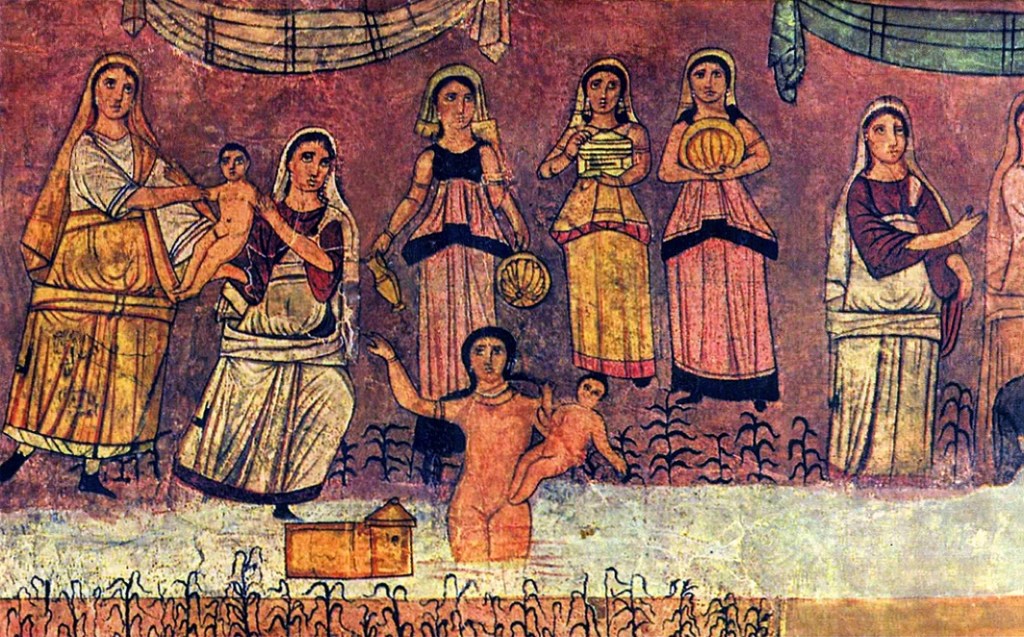
    fresco from dura-europa of egyptian princess pulling moses from water while Jochobed, Miriam, and the princess' attendants look on.

    Miriam was one of Israel’s first leaders and a prophetess for her people. Unlike most women in the Bible, Miriam receives a considerable amount of textual attention. This four-part series surveys some aspects of Miriam’s character and characterization in biblical stories, non-biblical texts, and legendary material.

    Miriam’s first appearance is in Exodus 2 although she is not identified by name. In Womanist Midrash, Wilda Gafney suggests that perhaps the reason she is unnamed is because of her noteriety. Regardless of the historical reasons for the young girl’s namelessness, scholars almost universally agree that this daughter is Miriam. 

    In the Exodus story, the unnamed Pharaoh determined that there are too many Hebrew slaves and worried that they might side with an enemy in the event of a war. He decided to treat the slaves even more ruthlessly and oppressively than before. Yet the Hebrews still multiplied their population. Pharaoh then decided that every male child born to kill every male Hebrew child. To achieve this, he assigned two Hebrew midwives to the task, Puah and Shiphrah. These midwives did not kill the children so Pharaoh took his infanticidal policy to the Egyptian people telling them, “Every boy that is born to the Hebrews you shall throw into the Nile, but you shall let every girl live” (1:22).

    Moses’ mother, named Jochobed [Exodus 6:20 and Numbers 26:59], managed to hide Moses for three months. She then devised a plan that technically follows the Pharaoh’s command but does not kill her son. Placing Moses in a papyrus basket, she set him among the reeds on the bank of the river. Miriam, then, stood watch to see what would happen to her brother.*

    The Pharaoh’s daughter, also unnamed, saw Moses and took pity on him, noting that he must be one of the Hebrew children. Miriam then stepped forward and asked the princess if she should secure a wetnurse for the child. Critically, Miriam asked this before the princess made any mention of adopting the child.  The princess agreed and Miriam secured her mother as Moses’ wetnurse. Presumably Jochobed would have worked within the royal household though not necessarily under the princess’ supervision.  After Moses was weaned, he is returned to the Pharaoh’s daughter and she raised him as her son. 

    By securing a wetnurse, Miriam secures survival for her brother and, ultimately, for her people. She does not wait for the Pharaoh’s daughter to speak before she boldly steps forward and negotiates her brother’s life, adoption, and care with a woman who could have had her killed alongside her brother. Jubilees extends this protector characterization by showing her to be a constant guardian for Moses while he is most vulnerable before negotiating his adoption into the Pharaoh’s household.


    *The book of Jubilees (c. 160-140 BCE), a recasting of the familiar canonical texts, adds a curious detail.  Jubilees 47:4 says that Moses was in the basket for 7 days, his mother would nurse him by night, and Miriam would protect him from the birds during the day.


      Other posts in this series

      Miriam the Prophet

      Miriam the Community Leader

      Miriam in Biblical Memory and Legend

    • Remembering Mary Magdalene

      The New Testament Texts
      First, the only part of her popular contemporary legacy that has any biblical basis is that she was exorcised of 7 demons. This is recounted both in Luke 8:1-2 and Mark 16:9.  However, as a note, Mark 16:9 is from the so-called Longer Ending of Mark which is not found in the earliest manuscripts.  Most scholars believe it was added in the late 2nd or early 3rd centuries and likely was intended to line up the Markan account with the Lukan account.  In any event, the biblical text does claim that Mary was possessed by 7 demons.  Let me stress, underline, and all-caps that the understanding of demon possession in the ancient world was not simply about someone becoming a mouthpiece of the devil, nor was it necessarily a reflection of some sort of moral failing on Mary’s part.  Demons were thought to be responsible for a whole litany of human problems – from sickness to bad luck.  Perhaps we are to understand that Mary was possessed because of some moral failing on her part.  But perhaps we are to understand that Mary was extremely ill when she encountered Jesus.  The text isn’t clear, and I, for one, am in favor of giving Mary the benefit of the doubt.

      Second, Mary is the first to experience an appearance of the risen Christ.  Mark 16:9 explicitly states that Mary was the first person to whom Jesus appeared.  In Matthew 28:9-10, Mary and the “other Mary” (not Jesus’ mother — the other one!) encounter Jesus who sends them to tell the disciples to go to Galilee.  In John 20:14-18, Mary encounters Jesus in the garden, first mistaking him for the gardener before he simply calls her name and she sees him for who he is.  It’s really a quite beautiful moment.  

      Third, Mary was commissioned to deliver the explanation of the empty tomb to the male disciples.  She is sometimes referred to as the Apostle to the apostles.  Her commissioning is told in Mark 16:7, Matthew 28:7, and John 20:17.

      Jane Schaberg describes Mary’s New Testament presence like this: “According to all four Christian Testament gospels, Mary Magdalene is a — perhaps the — primary witness to the fundamental data of the early Christian faith.  She is said to have participated in the Galilean career of Jesus of Nazareth, followed him to Jerusalem, stood by at his execution and burial, found his tomb empty and received an explanation of that emptiness.”(1)

      Conflating Mary with other NT women
      The assumption that Mary was a sex worker is actually an unfair conflation of Mary with other women in the Gospels.  Mary’s unsuccessful attempt to anoint Jesus in the tomb often gets linked to three other anointing scenes: Mark 14:3-9 with its parallel in Matthew 26:6-13, John 12:1-8, and Luke 7:36-50.  In each of these three scenes, a different woman is described as anointing Jesus’ feet.  Only in the case of Luke 7:36-50 is the woman actually presented as a sex worker (which probably meant that she was a slave woman, but that’s a detail for another day).  None of those women are named and none of them are Mary Magdalene.

      Erasure of Mary’s Role among Early Jesus Followers
      In Galatians 1:18-19, Paul talks about how, after his encounter with the risen Christ on the road to Damascus, he went to Jerusalem and spent some time with Peter and James only.  He makes no mention of Mary, or any of the other disciples.  Paul also omits Mary from his list in 1 Corinthians 15:5-8 of those who encountered the risen Christ, even going so far as to say that Christ appeared to Peter and the other disciples first.  Now, if Paul learned the story from Peter and James when he was in Jerusalem, then that means that Peter and James omitted the women from the story.  The alternative is that Paul chose to omit them.  Since the Gospels were written after Paul wrote his letters (Paul was writing in the 50s and the Gospels were written from the late 60s to perhaps the 80s), perhaps the Gospel writers told the story of the women to set the record straight.  

      Mary in Early Christian literature
      Mary’s early legacy extended beyond the texts that made the New Testament.  She is found in several early Christian texts, including 5 found at Nag Hammadi: The Gospel of Thomas, Dialogue of the Savior, First Apocalypse of James, Gospel of Philip, and the Sophia of Jesus Christ.  She also has a gospel in her name: the Gospel of Mary.  In this material, attention is paid to her apostleship and speaking.  She is not denigrated as a “sinner” or “whore.”  She is a prominent follower of Jesus, a woman who spoke boldly and had a leadership role corresponding to that of the male disciples.  Though often in open conflict with the male disciples, her place was defended.  She was a visionary who was praised for her superior understanding.  She was identified as an intimate companion of Jesus.(2)

      Mary’s Legacy
      Mary’s legacy is so much more than “reformed sinner.” She was a faithful follower of Jesus, even to end.  She was there when he died and she encountered him first when he rose. She is a model of leadership and devotion for all.  It’s high time to set her story straight. 

      (1) Schaberg, Jane. The Resurrection of Mary Magdalene: Legends, Apocrypha, and the Christian Testament. New York: Continuum International Publishing, 2002; 65-66.

      (2) Schaberg, Jane. The Resurrection of Mary Magdalene: Legends, Apocrypha, and the Christian Testament. New York: Continuum International Publishing, 2002; 129.

    • Mark 6 and the Performance of Power

      George Orwell once wrote about his experience of shooting an elephant as “enlightening” in that it “gave me a better glimpse than I had had before of the real nature of imperialism—the real motives for which despotic governments act.” Orwell, as a subinspector of police in colonial Burma, was called upon to deal with an elephant that was in heat and wreaking havoc in the bazaar. When an armed Orwell found the elephant, it was behaving peacefully and no longer appeared threatening. However, with over two thousand locals watching him, he realized that he would have to shoot the elephant anyway. As Orwell put it, “The people expected it of me and I had got to do it; I could feel their two thousand wills pressing me forward, irresistibly.” Orwell, as an official of the colonizing nation, was a representative of a system that made certain claims to justify their dominance. His decision regarding the fate of the elephant would result in reinforcing that claim or in ridicule. “And my whole life, every white man’s life in the East, was one long struggle not to be laughed at.”

      This story finds an interesting conversation partner in Mark’s telling of John the Baptist’s beheading. Herod hosts a dinner party with many of the local elite in attendance. His unnamed daughter dances for him and his dinner guests. In response, Herod promises the girl up to half his kingdom (*technically* not his to give). She discusses with her mother, Herodias, and comes back asking for John’s head on a platter.  Mark 6:20 illustrates the ambiguous way that Herod viewed John; Herod feared him, recognized that he was holy and righteous, protected him, was perplexed by him, and enjoyed listening to him. His ambiguous feelings towards John coupled with his oath and the presence of his dinner guests left Herod “deeply grieved” (περιλυπος, 6:26).

      For Herod, his elephant is John and his locals are his dinner guests. Herod promised the girl up to half of his kingdom. Though it is not technically his to give, it is a claim to (imagined) power and authority—a claim made publicly. Fortunately (or unfortunately) for Herod, the girl requests something that he can deliver – the Baptist’s head. For Herod to publicly act in a manner contradictory to his oath would be a threat. He must conform to the ideas legitimating his authority, and he has an audience of powerful elites watching to make sure he does so. Herod, like Orwell in James Scott’s assessment, “is no more free to be himself, to break convention, than a slave would be in the presence of a tyrannical master.”[1]  The passive silence of Herod’s dinner guests seals the fate of John the Baptist. Herodias, the character most often held responsible, does little more than advise on her daughter’s request, though the weight of her influence should not be understated. Though Herodias may find the most satisfaction in John’s demise, she has no poåwer in the outcome of the oath and her reaction is not mentioned.  However, Herod’s dinner guests, the elite of Galilee, who sit silently, ensure that Herod fulfills his word. They are the “two thousand wills” pressing Herod forward. They exercise an enormous amount of power by their presence; their silence ensures John’s execution.


      [1] James C. Scott, Domination and the Arts of Resistance: Hidden Transcripts (New Haven: Yale University Press, 1990), 11.