Rachel’s Long-Awaited Sons
The matriarchs hold a special place in the Hebrew canon and society. They are so much more than “Jacob’s wives” or “the mothers of the Children of Israel.” In this post, we will look at the naming speeches for Rachel’s sons and draw conclusions regarding what they tell us about a family’s complicated dynamic.The naming speeches in this passage come to a triumphant end with the birth of Joseph. “Then God remembered Rachel, and God heeded her and opened her womb. She conceived and bore a son, and said, ‘God has taken away my reproach’; and she named him Joseph, saying, ‘May the Lord add to me another son!’”
Joseph
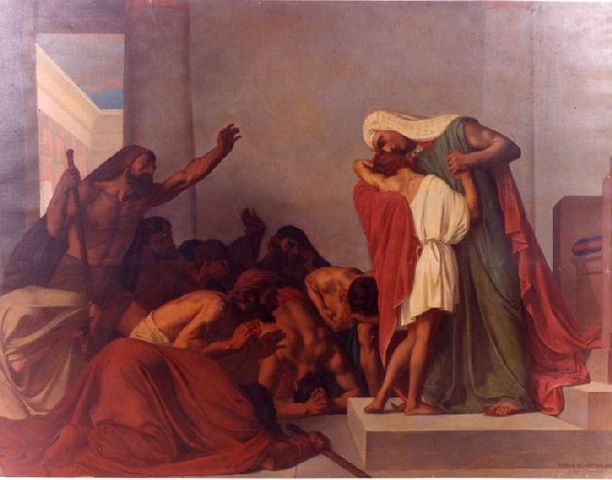
The barren Rachel is finally remembered by God and given a child. As with Leah, God is an active participant. It is God who opens Rachel’s womb; it is not the work of the mandrakes nor is it a reward for giving Jacob Bilhah (as Leah assumed in the naming of Issachar). Rachel’s response is to say that God has taken away her reproach. She may have felt vindicated by God with the birth of Bilhah’s son Dan, but it is only in the birth of Joseph, which means “addition,” that removes her reproach. She ends by asking the Lord for another son. She now recognizes that the solution to her infertility lies in the realm of the divine. God is a God who remembers the afflicted and works for their benefit.
Ben-oni / /Benjamin
The final naming comes in Genesis 35:16-21.
They journeyed from Bethel; and when they were still some distance from Ephrath, Rachel was in childbirth, and she had hard labor. When she was in her hard labor, the midwife said to her, “Do not be afraid; for now you will have another son.” As her soul was departing (for she died), she named him Ben-oni; but his father called him Benjamin. So Rachel died, and she was buried on the way to Ephrath (that is, Bethlehem). And Jacob set up a pillar at her grave; it is the pillar of Rachel’s tomb, which is there to this day. Israel journeyed on, and pitched his tent beyond the tower of Eder

In this passage, Rachel names her son, but Jacob inexplicably renames him. Wilda Gafney puts it this way, “The name Rachel chooses for her second son, Ben-oni, ‘son of my sorrow,’ is not honored by Jacob. He renames the boy Ben-yamin, Benjamin, ‘right-hand son.’” There is no accompanying birth-speech, except perhaps that of her midwive reassuring her that she is having a boy. It is a tragic end to a complicated story.
An Epitaph for Rachel
Lament and blessing characterize the portrayal of Rachel in the Scriptures: a pawn of her father, in conflict with her sister, loved by a man she does not say she loves, ashamed of her infertility, and finally a mother granted fertility by God, dead before seeing her children grown and married, her deathbed wishes disregarded.1
Wilda Gafney
A Summary of Sibling Rivalry
Leah and Rachel are sisters who are locked in a competition with one another. The thing the women didn’t seem to realize is that they are fighting for different things.
Leah is seeking the favor of Jacob. She desires for him to love her, and this desire comes through in the way she names her children. Her first and last children are both announced with the hope that Jacob will become attached to her, will love her, will favor her. Any jealousy she may feel towards Rachel has nothing to do with their social status, but with their status in the home.
Rachel, on the other hand desires children. She desires a status in society comparable to the status she holds with Jacob. She is favored, and even her barrenness cannot persuade Jacob to reject her. A child, specifically a son, is the one thing she wants and the one thing she cannot have. Despite all her attempts to manipulate her situation and become a mother, she remains barren while Leah mothers seven children until finally God opens her woman allowing her to conceive.
And yet, it is that very gift of children that will kill her; the giving of life takes her life. A darkly ironic moment in a very complex story.
The Sisters Beyond Their Children
The conflict inherent in the nature of the Leah-Jacob-Rachel love triangle seems almost difficult to overcome. However, reader, do not give up hope! ‘
Later we see Leah and Rachel working together for the sake of Jacob in Genesis 31:1-16. Jacob describes to Leah and Rachel the work he has done for Laban, how the Lord has given all of Laban’s flock over to Jacob, and how Laban has looked less favorably upon Jacob because of this.
He then tells them that God has told him to return to his birth land. Leah and Rachel agree that they too are perceived as foreigners in their father’s home and have lost their inheritance. It is better for them to remain with Jacob and do as the Lord has commanded Jacob.
In this scene, there is no rivalry, no in fighting. For their own sakes, and for the sake of their children, they join Jacob to flee from Laban. Perhaps, despite all odds, there is hope that peace can happen in the midst of conflict. But that is a discussion for another day.


Leave a Reply